TEA GUIDE
Ten Thousand Egrets 2026: Best Time, Where to Watch, Parking and Route in Taixing, Meishan
The 2026 Ten Thousand Egrets gathering happens at Taixing, Meishan, Chiayi, from August to October, at its best between 3pm and dusk. The most comfortable way to watch is from Xinchun Tea House: NT$150 per person with parking, toilets, shaded seating and cold-brew high-mountain tea, staying until the flock disperses; add a 90-minute guided walk for NT$450. The viewing platform car park next door is free but has no seating and no toilets. Timing, location, parking, route and what to do in the rain — written by the family who lives where the birds pass.
Updated September 27, 2026
This season has ended — see you next yearWhat this guide answers
- What is the "Ten Thousand Egrets"?
- Why "Ten Thousand Egrets"?
- What bird is it, where does it come from, and where is it going?
- When should you come?
- Where do you watch, where do you park, and what does it cost?
- Are there toilets? How long can I stay?
- How should I plan the day? Should I stay overnight?
- How this started
- A few things to know before you come
- If you are here to photograph
- If you would like a guide
- Do I need to book? Can I just drive up?
What is the "Ten Thousand Egrets"?
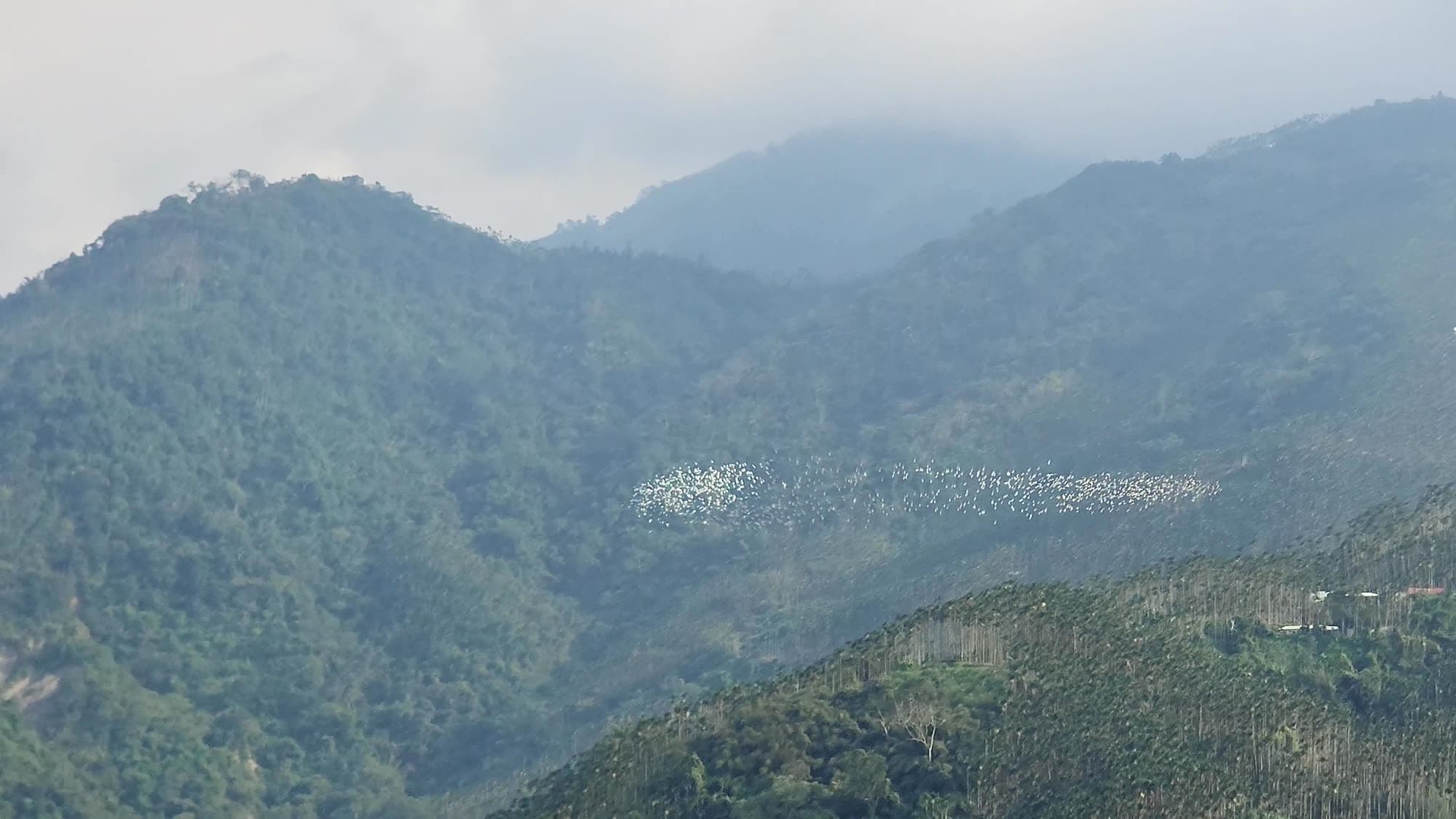
From August to October each year, flocks of cattle egrets sweep across the tea hills of Taixing Village in Meishan, Chiayi. On the best days the whole valley fills with birds. Locals call it wan lu chao feng — the ten thousand egrets.
It is not a built attraction. It is something that happens on its own, which means timing matters more than anything else: come at the right hour and you see it; come at the wrong one and you see a very quiet tea hill.
Why "Ten Thousand Egrets"?
The name comes from the landscape. Locally, this stretch of the Shengmaoshu Creek valley in Taixing Village is said to resemble a phoenix nest; as the egrets spiral up the valley and sweep over the ridge in formation, they look like ten thousand egrets paying homage to a phoenix — hence the name.
The valley shape is also why it looks the way it does: the terrain funnels the birds into a single moving band rather than letting them scatter.
What bird is it, where does it come from, and where is it going?
The star of the show is the Eastern Cattle Egret. It is not the Little Egret most people picture when they think of a white egret: the cattle egret has a yellow bill and black legs, while the Little Egret has a black bill and black legs with yellow feet. In the breeding season the cattle egret grows orange-buff feathers on its head, neck and chest, which is where its Chinese name, "yellow-headed egret", comes from.
Cattle egrets mostly eat insects and frogs, picking off insects flushed up in grassland and farm fields; Little Egrets mostly fish along streams and the coast.
Are they migratory? Yes. Taiwan's Ministry of Agriculture lists the cattle egret here as a summer visitor, winter visitor and passage migrant, noting that whether any are resident still needs study. The big autumn flocks over Taixing are birds passing through on their way south.
Where do they come from, and where are they going? According to the Alishan National Scenic Area Administration, from around White Dew (early September) to Taiwan's National Day (10 October), large numbers of cattle egrets fly from the north to winter in warmer Southeast Asia, entering the Shengmaoshu Creek valley at Taixing by way of Zhanghu in Gukeng, Yunlin. There is more than one route south: big flocks are also seen each autumn at Shimen Reservoir in Taoyuan, further north. These routes are pieced together from years of local sightings; no banding or satellite-tracking study has confirmed them yet.
Why here? Again per the Scenic Area Administration: the shape of the Shengmaoshu valley creates shifting air currents, and the flocks use them to circle and reshape over the valley before crossing the ridge together and carrying on south. In the decades we have watched, the flocks circle longer over this stretch of the valley at Taixing before heading over the ridge, which is exactly why it photographs so well and why it became famous.
When should you come?
The season runs from August to October. The flocks are generally said to be at their densest between the solar terms of White Dew and Cold Dew — roughly early September to early October.
Within a day, the birds start arriving around 2pm, and the spectacle peaks between 3pm and roughly 6pm, as wave after wave enters the valley, circles and reshapes overhead, then crosses the ridge heading south.
Outside that window you need a good deal of luck. If you can only make the drive once, come after three in the afternoon.
That said, no two years are the same and the weather has a say. We are here every day — if you want to check before setting off, call us on 0972-619-391 (someone answers 8am to 10pm, daily).
Where do you watch, where do you park, and what does it cost?
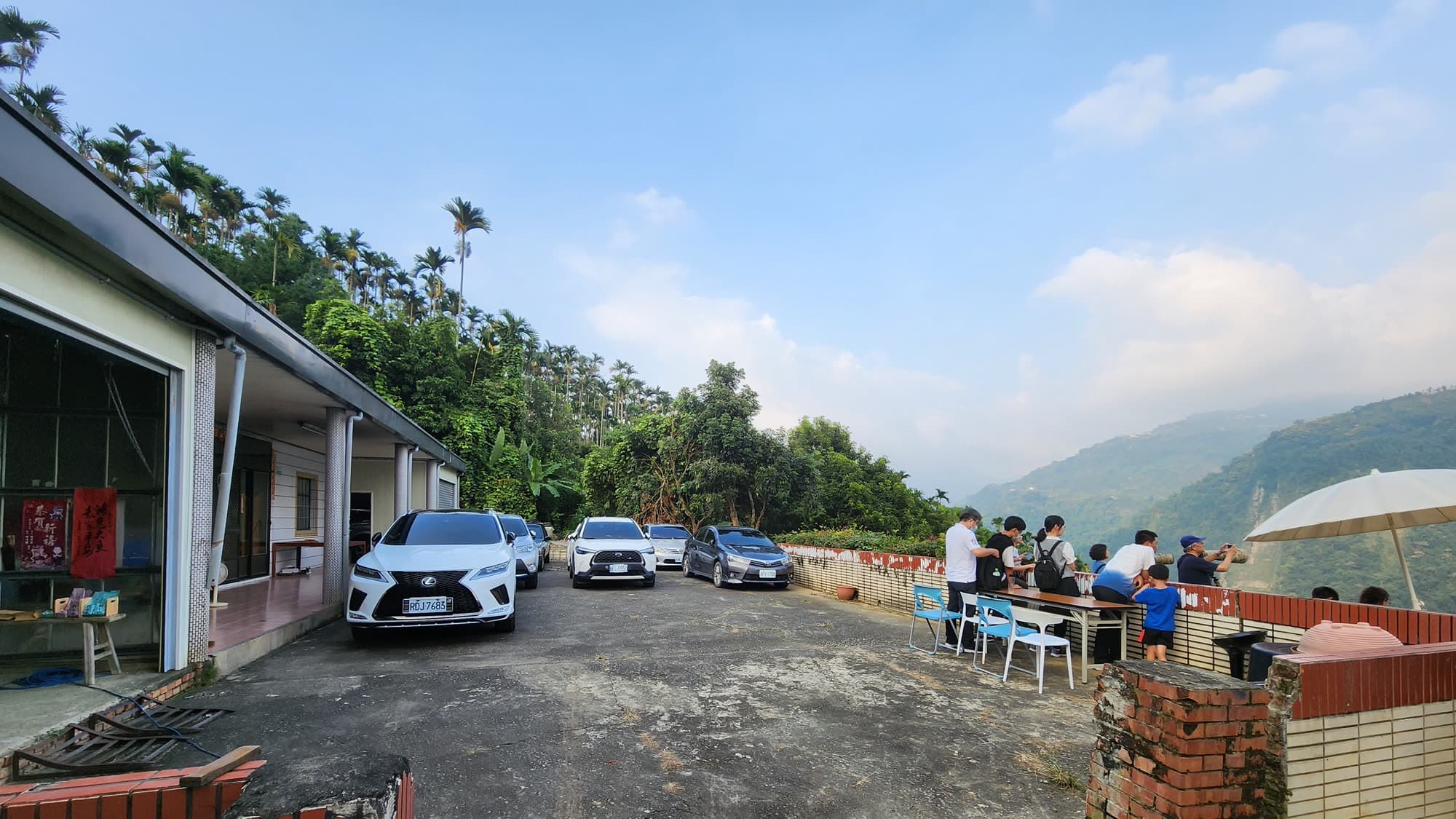
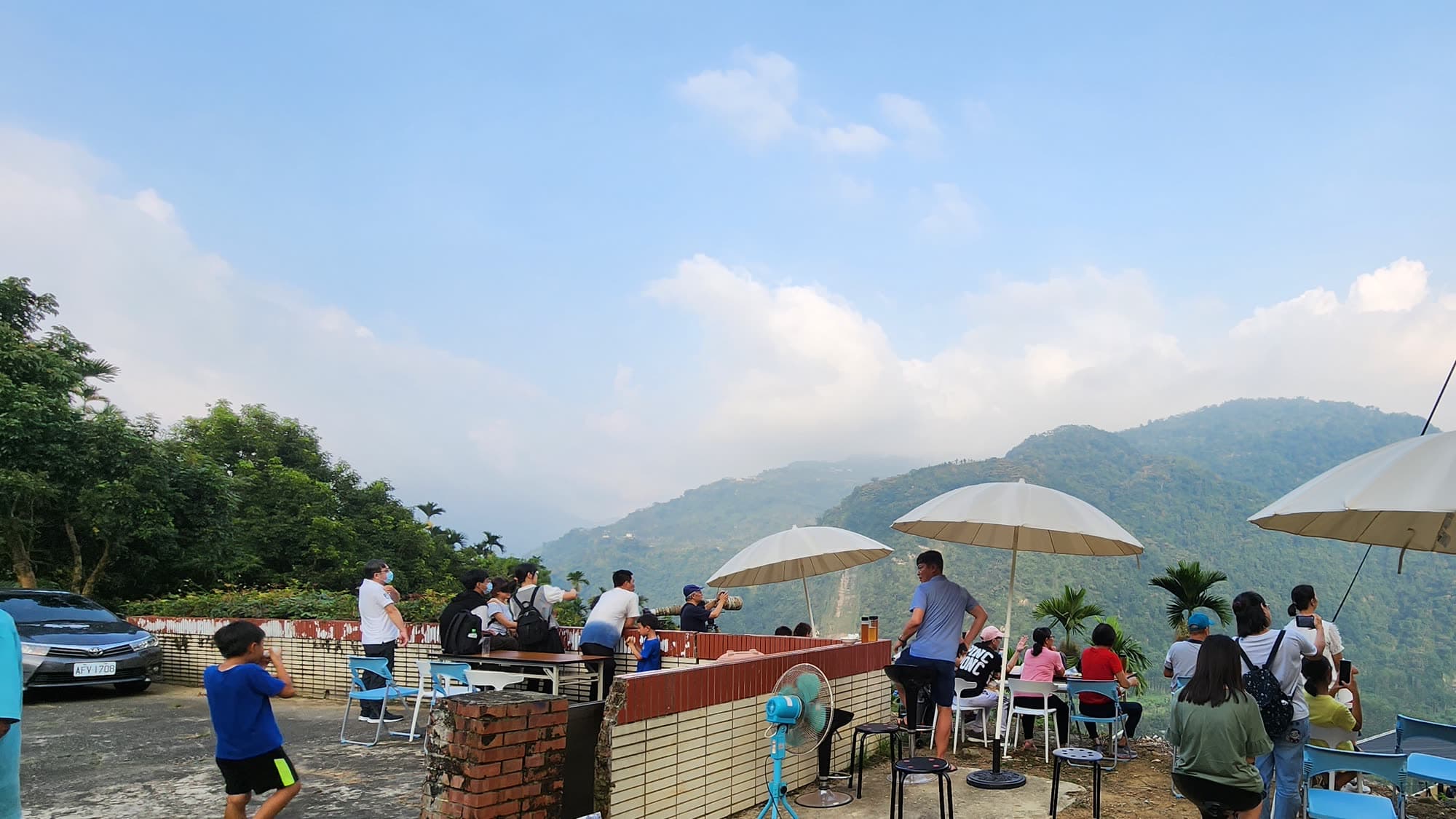
For the Ten Thousand Egrets, we suggest waiting at Xinchun Tea House. On weekdays you drive right up to the door — no trail to walk first, so strollers and older visitors are fine (for weekends and public holidays, see parking below) — and there is shaded seating, toilets, and a superb view straight out over the valley the flock crosses.
Garden admission is NT$150 per person, including a bottle of cold-brew high-mountain tea and the snack of the day, parking included, and you can stay until the flock disperses. For the two or three hours of waiting you have a seat, tea, and toilets — no standing about in the wind.
Booked the tour: drive to Xinchun Tea House as well — that is the meeting point, and parking is already covered by your tour fee.
On weekdays parking is no problem; at weekends and on public holidays, plan on parking by the roadside. The tea house has only seven spaces, and some are held for guests on the guided tour. Most visitors arrive after 2pm and leave together around 6pm, so on egret-season weekends and long weekends the spaces go quickly, and the viewing platform car park next door may be full too; arrive before 2pm for the best chance of a space at the tea house. Once the tea house is full we block off the entrance — if you find it blocked, park along the white-lined roadside nearby and walk in. Please don't park on red or yellow lines, and keep clear of house and farm-track entrances.
With older relatives, children or a stroller, let them out at the entrance first — it is a one to two minute walk in — then go and park. Share cars if you can; a scooter is far easier to park. When everyone leaves around 6pm it is already getting dark, so if you parked on the roadside, keep to the edge and watch for cars on the walk back. Any parking questions, before you set out or once you are here, call us on 0972-619-391.
Other places in Taixing where you can see the birds, briefly: a 3 to 5 minute walk from the tea house is what Google Maps lists as 梅山太興村賞黃頭鷺景觀平台停車場 (the viewing platform car park), free to park but with no toilets or seating; Google Maps also lists 太興飛瀑停車場-黃頭鷺觀鷺平台; and a few neighbouring households, such as 阿村師的家, 草本傳奇, 太興翔億樓民宿山莊 and 鴻朋觀景家庭咖啡廳, open viewing decks too — most are shops or guesthouses, so check terms with them directly. Wherever you watch from, if you want to sit down, need the toilet or would like some tea while you wait, you are welcome at Xinchun Tea House.
Also note that 樟湖黃頭鷺觀景台 (the Zhanghu viewing deck) on Google Maps is in Gukeng, Yunlin: the birds pass it on their way into Taixing, but it is a different place from here, so double-check your navigation.
Getting here: driving route, bus and scooter
Navigate to Xinchun Tea House: the seats, toilets, tea and the tour meeting point are all here. If its spaces are full, the viewing platform car park next door works too.
- Directions to Xinchun Tea HouseToilets and seating · tour meeting point
- Directions to Cattle Egret Viewing Platform Car ParkFree · no toilets or seating
- Meishan Interchange
- about 44 min
- Chiayi City
- about 60 min
- THSR Chiayi Station
- about 70 min
From Meishan Interchange the road climbs through the 36 bends at Taiping. Plenty of curves, but sealed the whole way: an ordinary car gets you to the door — no 4WD needed, and passing oncoming traffic is not a problem. The birds wind down around 6pm and it gets dark quickly in autumn, so take the bends slowly on the way down.
No car? Take the bus from Meishan station to Hengshan stop. From Hengshan it is about a 20 to 24 minute walk to the viewing platform car park, and Xinchun Tea House is another 3 to 5 minutes on. The birds are best towards dusk, so check the bus times both up and back down before you set out, and allow 20-odd minutes to walk back to Hengshan stop. A scooter is even easier: much simpler to park than a car, and you are welcome to ride straight to Xinchun Tea House.
No. 19-2, Xitou, Taixing Village, Meishan Township, Chiayi County
Are there toilets? How long can I stay?
Yes. There are toilets at Xinchun Tea House, and shaded seating.
Worth asking before you set off, because watching takes two or three hours — the birds start arriving around 2pm and the spectacle peaks between three and six. If you are bringing children or older family, this is the thing to sort out first.
The free viewing platform car park has no toilets and no seating; it suits a quick look. To stay longer, come into the tea house: NT$150 per person, including a bottle of cold-brew high-mountain tea and the snack of the day, parking included — and you can sit until the flock disperses. There is no time limit.
How should I plan the day? Should I stay overnight?
The egrets are an afternoon affair. On a day trip, arrive before 2pm; the main event starts after three, and the last flocks cross the ridge around six. Then head down.
The morning need not be empty: pair it with a two-hour tea experience here on the same day. It is the same drive up, and the second experience is 10% off (details at the end of this page).
If you want to stay the night, the Chiayi County Cultural and Tourism Bureau has suggested staying around Taixing, Taiping or Ruili, since the birds depend on the weather and a day trip can occasionally miss them. To avoid that, check the latest sighting above before you set out, or call us on 0972-619-391 to ask whether the birds are flying today.
How this started
Word of the Ten Thousand Egrets spread from the egret viewing platform car park and the viewing decks of several neighbouring families — not from any one household. Government offices and journalists came later, and visitors shared what they saw online; that is how it became known.
Our family of three has grown tea in Taixing Village for more than 40 years. The birds come every year, and we are here every year — which is why we can tell you which afternoons are worth the drive and which are not.
A few things to know before you come
Rain does not mean no birds. Once the season is in, the flock flies most days — heavy rain is the exception. In ordinary rain, if the birds have been flying the past few days, they will most likely pass over that day too. If you are unsure, call us on 0972-619-391 before you set out.
Bring a layer. Evenings get cool up here, and the best hour is the evening.
No drones. The Chiayi County Government has banned drone flights below 400 feet over the Shengmaoshu Creek area of Taixing from 11 September to 31 October 2026, with fines of NT$30,000 to NT$150,000. Fines aside, one drone can scatter the whole flock, and everyone who arrives after you sees nothing.
If you are here to photograph
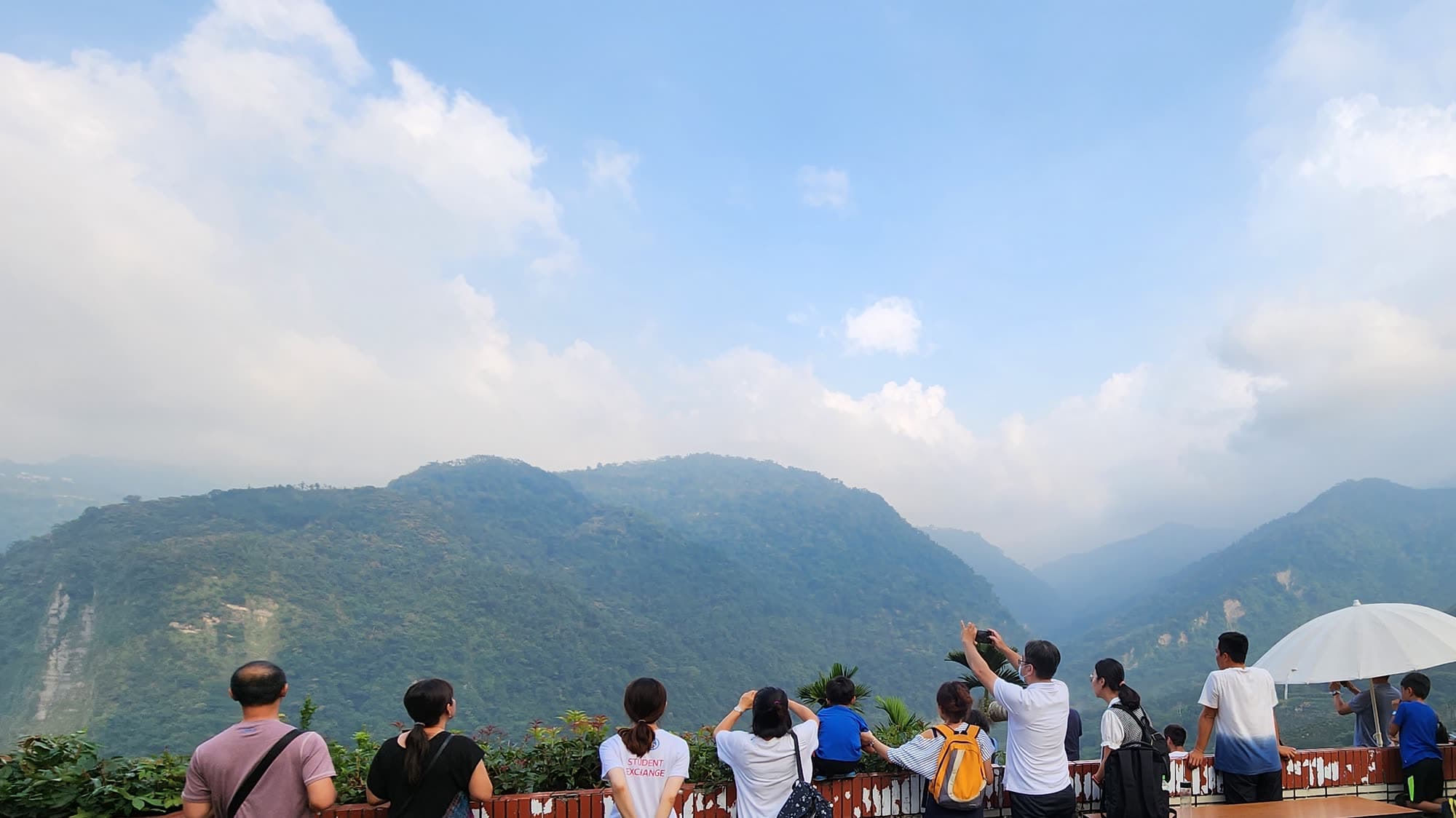
From the seats at the tea house you look straight out over the stretch of valley the flock crosses every afternoon — a superb view. Wave after wave passes from left to right, easy to follow with a long lens or to film on your phone. There are a few power lines by the buildings, off to the right and low in the frame, but they basically never get in the way of the flock; only when birds swing somewhere unusual do you need to adjust your framing a little.
The best hour is also the best light. From about four the flock is at its densest and the light has softened. If you only have one hour, make it that one.
Drones are banned here during the season (see the county notice above), so a long lens is the way to get the flock.
If you would like a guide
The Ten Thousand Egrets Tea Hill Tour is NT$450 per person, 90 minutes, running 22 August to 11 October and starting at 2pm.
The tour ending is not your cue to leave. The talk finishes around 3:30pm, just as the birds start to build — and you are welcome to stay on at the tea house until the last flock crosses the ridge around six, or until you feel like leaving. The seat is yours, the tea keeps coming, the toilets are right there. NT$450 buys the whole afternoon, not ninety minutes.
The price already includes everything in garden admission: cold-brew high-mountain tea, the snack of the day, parking, toilets, a shaded seat. What it adds is a local guide with you throughout, an ecology booklet to take home, and freshly made handmade mountain-spring fig jelly — on tour days we always make it.
One thing that matters more than the talk itself: the tour is booked ahead, so your seat and your parking space are both held. On egret-season weekends and long weekends the cars all arrive after 2pm and the tea house's seven spaces fill fast — for tour guests we keep spaces aside. After booking, give us a call to say how many cars you are bringing, and we will tell you how to get in and park.
The person guiding you is the person who wrote this guide — the family that has grown tea in Taixing for more than forty years, here every year the birds come. Two people is enough to run a session. Book online, or call us on 0972-619-391 (8am to 10pm, daily).
You are just as welcome to come and watch without booking anything. This was always something people watched together.
Do I need to book? Can I just drive up?
No booking needed — just drive up to Xinchun Tea House. Parking is no problem on weekdays, but the tea house has only seven spaces, so on egret-season weekends and long weekends plan on parking by the roadside: if the entrance is blocked off, it is full — see "where do you park" above. Call us any time with parking questions.
To sit down and wait properly, a tea seat is NT$150 per person, paid on the day by cash or bank transfer (we do not take cards): a bottle of cold-brewed high-mountain tea, the snack of the day, and shaded seating you can keep until the flock disperses, with no time limit. If you would rather have something hot, add a freshly brewed pot for the table — NT$300, refilled as long as you stay.
Only the Ten Thousand Egrets Tea Hill Tour needs booking ahead. It leaves at 2pm daily and costs NT$450 per person.
Any questions on the way up, call 0972-619-391 — someone answers between 8am and 10pm every day. We live here.
Want to see it for yourself?
Everything in this guide happens on our own tea farm — you can book online.
Someone answers 08:00–22:00 daily — the same family who wrote this guide.
Same day, a little longer on the mountain
The tour starts at 2pm, so the morning is wide open. The drive up is the same either way — book two experiences on one day and the second is 10% off.
Pick what you want online, then call us and we will space the times out for you.